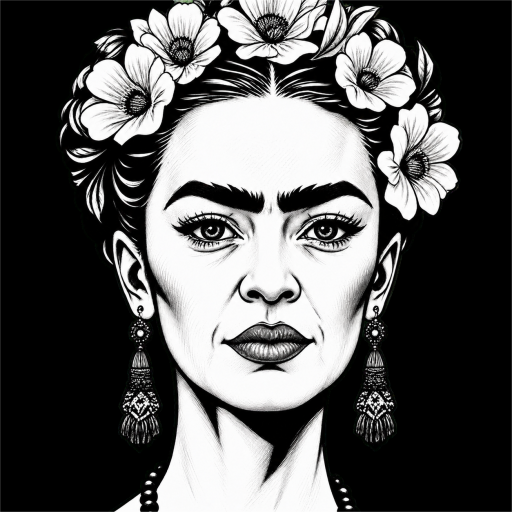
The Expressionist
Structure + Depth
Drives progress through emotion, meaning, and lived experience.
CreateMethod is not another personality test for your team. It is a practical framework that helps leaders diagnose operational friction and build individually aligned execution skills across your team.
Understand how your people work.
Learn to identify what breaks momentum.
Develop the skills that keep critical work moving.
People approach work differently along two primary dimensions.
How someone organizes, sequences, and executes tasks.
How someone develops ideas—either diving deep into one line of thought or drawing connections across disciplines.
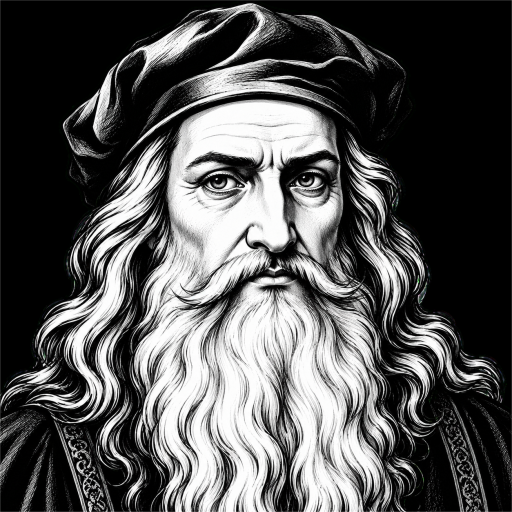
Each archetype has a famous artist as a "muse," a call back to the roots of this method.
Structure + Depth
Drives progress through emotion, meaning, and lived experience.

Spontaneity + Breadth
Challenges systems, questions assumptions, and spots opportunities early.
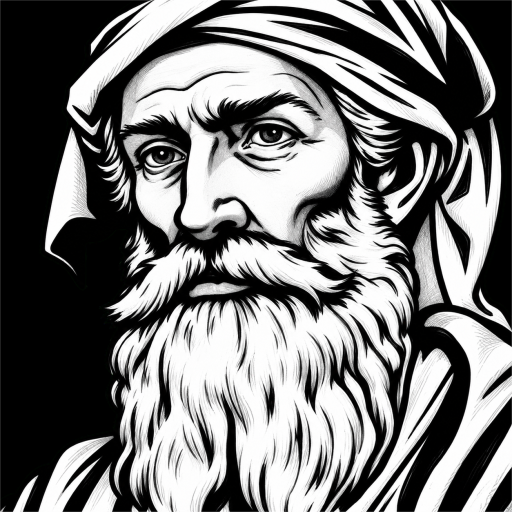
Spontaneity + Depth
Converts vision into structured, long-term operational outcomes.

Structure + Breadth
Executes through independence, originality, and bold non-conformity.

Structure + Depth
Eliminates friction to focus on clarity, precision, and core priorities.
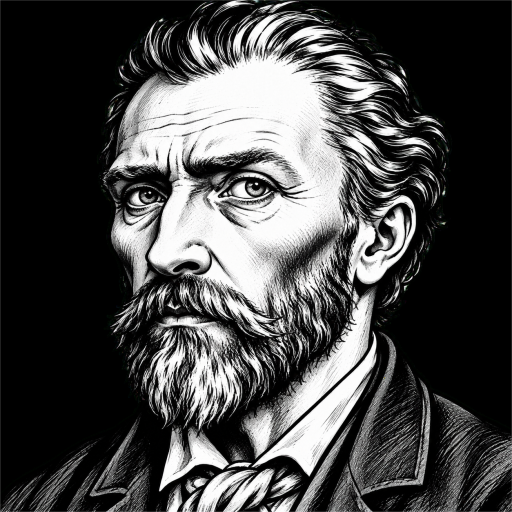
Structure + Depth
Brings intense commitment and deep ownership to the work.
Spontaneity + Breadth
Integrates cross-disciplinary patterns and complex possibilities.

Spontaneity + Breadth
Decodes momentum quickly to launch ideas into the market at speed.
Creative cognition depends on coordination between brain systems involved in spontaneous thought, evaluation, attention, and cognitive control. There are three large-scale neural networks needs for innovative work.
Associated with internally generated thought and idea generation
Involved in evaluation and goal-directed thinking
Which helps prioritize relevant information and coordinate shifts in attention.
You can end up with twenty directions and no finished work.
Promising ideas can get filtered out before they have enough room to develop.
Each capability maps to a distinct part of how people generate ideas, build consistency, test, act, communicate, and extend their work. Together, these six practices help ideas move from possibility to completion.
Frame better questions, gather insight, and explore intent. Novel questions and information engage reward and learning systems that support attention and memory.
Build consistent rhythms and operational frameworks. Repeated behaviors can reduce the cognitive effort required to re-enter the work.
Test concepts early to refine next moves with live data. Testing, error, and feedback engage adaptive learning and error-monitoring processes. Experimentation brings learning into the work before a final outcome is at stake.
Convert strategy into tangible action, decisions, and deliverables. Putting ideas into action connects thinking with behavior and tangible feedback.
Frame ideas so clearly that teams can align and execute. Meaning-making connects internal thought with language, context, and interpretation.
Scale completed work outward for maximum impact. Ideas change when they enter the public sphere through feedback, imitation, collaboration, and social learning.
Note — The framework is informed by research in creative cognition, habit formation, behavioral psychology, and neuroscience.
An individual's archetype highlights natural strengths as well as predictable points where their momentum will likely stall. Each Archetype usually has at least two pillars they need to improve in order to develop their ability to ship more work.
AI is changing how teams create, communicate, and execute, but it doesn't change how your team members execute.
Individuals can carry their tendency to overthink, over-refine, resist structure, and/or struggle to communicate ideas into AI-assisted work, which can actually increase stalls.
Over-refinement, perfectionism, and difficulty releasing work.
Tests earlier; converts emotional investment into rapid output.
Holding work internally too long to perfect structural details.
Ships before every variable is resolved; scales deliverables faster.
Resisting structure post-breakthrough; struggling to communicate complex ideas.
Establishes execution rhythms; turns ideas into clear team action.

This method was incredibly practical. Knowing my archetype was eye-opening, and I saved every module so I can come back to it again and again. I'm using it for the things I'm building right now.

The CreateMethod put into words what I'd been feeling but couldn't articulate. It helped me understand my patterns and realize that my small moves make a difference, not just the gigantic ones.

This is SO GOOD!! These are the sorts of questions that I've learned to ask through spiritual direction, and I've experienced the power of directed reflection. Great way to reframe motivation and use passion to move people.
Reward + Learning
Habit + Consistency
Error + Adaptation
Thought Into Action
Meaning + Clarity
Connection + Social Learning
Learn a unified operating framework so that friction points in handoffs, decision-making, and execution are easier to diagnose and correct.
We will spend 20 minutes discussing your friction points and see if CreateMethod is a fit for your culture.
Your entire team and leadership get assessed. Managers are equipped with practical, archetype-specific tools for leading different working styles.
You reduce preventable friction and move high-value initiatives from strategy to completed output.
Get a sustainable way to move between generation, evaluation, and execution so ideas can develop and ship.